

Discover the real difference between green crackers and traditional firecrackers. Learn how eco-friendly firecrackers reduce pollution, what makes them “green,” and whether they’re truly better for the environment this festive season.

🌍 Introduction
Every year during Diwali, the debate reignites—should we burst firecrackers or not? While traditional fireworks bring joy and celebration, they also leave behind a cloud of toxic smoke and noise. Recently, “Green Crackers” have emerged as an eco-friendly alternative, promising lower pollution and safer festivities. Could we consider whether they are genuinely more beneficial for the environment? Let’s explore.
🎇 What Are Traditional Firecrackers?
Traditional firecrackers are made using a combination of chemicals like sulfur, potassium nitrate, barium, aluminum, and antimony sulfide. When ignited, these chemicals produce bright lights and loud sounds—but also emit carbon dioxide, carbon monoxide, sulfur dioxide, and fine particulate matter (PM2.5 and PM10) that linger in the air.
⚠️ Environmental and Health Impact
-
Air Pollution: Smoke from traditional crackers increases air pollution levels drastically, especially during the cold season when atmospheric dispersion is low.
-
Noise Pollution: Loud crackers can exceed 125 decibels, posing risks to the elderly, pets, and heart patients. (National Green Tribunal Order, 2023).
-
Health Issues: The chemicals released can trigger asthma, bronchitis, and eye irritation. (WHO – Air Pollution Factsheet).
-
Impact on Wildlife: Birds and stray animals suffer due to intense noise and smoke.
💚 What Are Green Crackers?
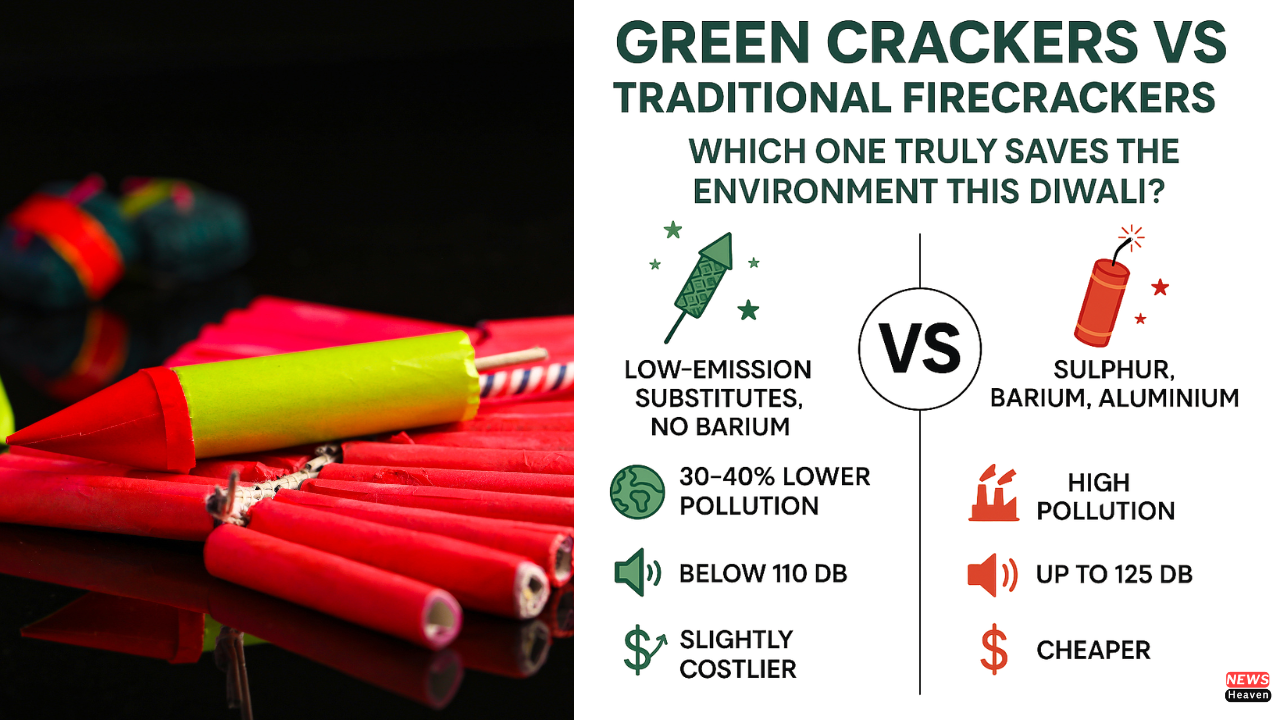
These are the results of research by CSIR-NEERI (Council of Scientific & Industrial Research – National Environmental Engineering Research Institute). These fireworks are designed to cause 30–40% fewer emissions compared to traditional crackers.
🧪 How They Differ
-
They do not contain harmful chemicals like barium nitrate or potassium chlorate.
-
The emission of sulfur dioxide and nitrogen oxides is significantly reduced.
-
They produce less noise (below 110 decibels).
-
Each certified product carries a unique QR code to confirm its authenticity.
🌱 Types of Green Crackers
-
SAFAL: Safe Minimal Aluminium Firecrackers
-
STAR: Safe Thermite Crackers
-
SWAS: Safe Water Releaser Crackers
These types aim to reduce toxic gas release and minimize particulate pollution.
⚖️ Green Crackers vs Traditional Crackers: The Key Differences
| Feature | Traditional Firecrackers | Green Crackers |
|---|---|---|
| Main Chemicals | Sulphur, Barium, Aluminium | Low-emission substitutes, no barium |
| Air Pollution | High | 30–40% Lower |
| Noise Level | Up to 125 dB | Below 110 dB |
| Health Risk | Severe | Mild to Moderate |
| Certification | None | QR Code by CSIR-NEERI |
| Price | Cheaper | Slightly Costlier |
| Availability | Widespread | Limited (yet expanding) |
🔬 Are Green Crackers Truly Safe?
While green crackers are a step forward, experts suggest they’re not entirely pollution-free. They still release smoke, fine particles, and carbon residues, albeit in reduced quantities. The greatest challenge lies in public awareness and proper manufacturing—many local producers falsely label ordinary crackers as “green.”
Therefore, purchasing certified green crackers with the NEERI QR code is crucial to ensure authenticity.
🎆 Government Regulations & Court Orders
The Supreme Court of India and the National Green Tribunal (NGT) have periodically restricted the use of polluting crackers. Many states now permit only green crackers during festive seasons, emphasizing a shift toward sustainable celebrations.
🌟 The Way Forward: Celebrate Responsibly
Choosing green crackers is a good step, but the ultimate goal should be a “noise-free and smoke-free Diwali.” You can celebrate by:
-
Lighting diyas and lanterns.
-
Supporting local artisans.
-
Organizing community light shows or eco-friendly fireworks displays.
-
Educating others about sustainable choices.
💬 Conclusion
Green crackers are not a perfect solution, but they are a promising compromise between tradition and environmental responsibility. As India moves toward cleaner and healthier festivities, small choices like opting for certified green crackers can make a big difference.
This Diwali, let’s make a pledge—burst joy, not the environment!